Showing posts with label Buddha - Buddhism. Show all posts

The Dynasty history of Buddhism

In India Buddhism started just over 500 years. The creator was Siddhartha Gautama, a younger elegant prince of a small northern Indian empire.

According to Buddhist tale, this prince’s dad expected his son would become a effective leader, and so Siddhartha was adorned with the high-class of dance ladies and satisfaction trips.

On one of these high-class trips in a elegant chariot the elegant prince saw an old poor dilapidated man, on a subsequent drive a sick and exhausted man, and on still another drive a corpse. On each of these trips the younger Prince, otherwise guarded from the severe facts of the world, requested his charioteer about the moments that stunned his sensibilities, asking, "And do we too develop old, become and exhausted, and die?" to which his charioteer responded to, "Yes".

These exposures to the facts of life set the elegant prince brooding. And so one evening after the dance ladies that were interesting him got exhausted out and decreased to the ground to get to sleep right at the front side of him, he ocurred, got his constant boy to carry him his equine, rode into the woodlands, ignored the constant boy and equine, and started his pursuit for satisfaction.

He first tried asceticism, a typical Hindu exercise at enough time, but it did not carry him satisfaction any more than his past satisfaction had. So he sat himself down under a Bodhi shrub, says Buddhist literary works, identified not to shift from there until he obtained enlightenment.

Biggest Buddhist Temple in Europe opens shortly

The finishing touches are being set on what will be Europe's largest Buddhist temple, inclusive with a 16-foot, 8-ton Buddha statue, said by officials.

The $20 million temple and educational center at Bussy-Saint-Georges, France, next to Paris, is to formally open on June 22, 2012 Radio France International reported this week.

All along with breathing space for 1,000 worshipers, the multifaceted will have about 40 bedrooms for people on religious leaves, prayer rooms, breathing space for meditation assemblies, lettering workshops and other actions and a vegetarian restaurant.

Intended by the Frederic Rolland architectural firm, the organization doesn't have the customary pagoda-style mainly linked with Buddhist temples. Put on a large packet filled with fruit trees, it is put up generally in glass, wood and whole concrete intonation by roof gardens. The key area is the huge Buddha finished of white jade from a peak in Myanmar.

"The statue was directly into a mountain in Burma and then elated to the haven of Marseilles, which at the time was on beat," architect Polly Rolland told RFI. "We had to systematize an extraordinary group, and organize cranes to point the Buddha within the temple, before dying the roof, since the statue wouldn't well through the doors."

Rolland said the plan was prominent for agreement during its construction. "Regularly there are constantly arguments on a spot, but this instance, the whole thing was supervised in a strength of total zen," the architect said.

International 3rd World Buddhist Forum opens in Hong Kong

The Third World Buddhist Forum, the Biggest International Buddhist Symposium ever detained in Hong Kong, opened on April 26, 2012.

At the inauguration of the opening ritual, guided by President of the Hong Kong Buddhist Organization Kok Kwong, President of the Buddhist Association of China Chuan Yin, including 11th Panchen Lama Bainqen Erdini Qoigyijabu and all the contributors, jointly with thousands of monks and Buddhist supporters, deformed three times to the statue of Lord Sakyamuni Buddha and chanted the Heart Sutra, one of the most well - known Buddhist scripture.


Important speech at the forum was delivered by The 11th Panchen Lama Bainqen Erdini Qoigyijabu, one of the two most senior living Buddhas in Tibetan Buddhism.

At some stage in the two-day event, reputed monks, well-known researcher from home and overseas, together with the India, Thailand, Republic of Korea, Japan, Australia, Sri Lanka, Cambodia, the United States and Europe, will contribute in seven sub-forums and numerous TV forums to argue the broadcast of Dharma knowledge and the defense of Buddhist scriptures, and replace thoughts on the growth of Buddhist education and the support of Buddhist benevolent efforts.

Russian Buddhist exhibition in India’s capital New Delhi

An exhibition devoted to the history of Buddhism in Russia has opened in India’s capital New Delhi.

The exhibition mainly displays photos, both old and present-day, of Buddhist monasteries located in those regions of Russia which are populated mainly by Buddhists – Kalmykia, Buryaia, Tuva, Altai and others.

Russia’s ambassador to India Alexander Kadakin is hoping that the exhibition will help Indians to learn more about the life of Russian Buddhists. Buddhism in Russia is steeped in rich traditions, and Russian Buddhists have always maintained close contacts with their Indian brothers and sisters in faith.

In 1741, a decree of Russian Empress Elizabeth II granted Buddhism the status of official recognition in Russia.

At present, there are 1, 4 mln Buddhists in Russia.

Angel in the clouds above Thai Buddhist temple

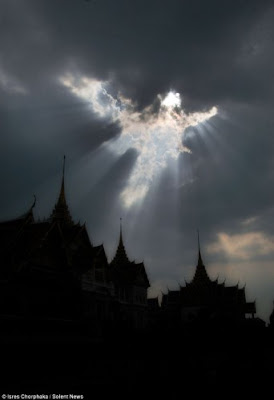
If Isres Chorphaka had wished to capture a heavenly vision, he had come to right place. The photographer saw this incredible angelic figure emerge from a dark, ominous sky as he visited a Buddhist temple in Thailand.

He feared a storm was brewing when he saw heavy clouds closing in. But he was stunned when rays of sunshine poured through gaps to form the stunning picture.

Angel in the clouds above Thai Buddhist temple

'There were a few hundred people at the spot but I didn't know how many saw it.

'I was also lucky because the Grand Palace in the foreground made the photo more dramatic.

'The phenomenon happened in less than 10 seconds. Luckily it was enough for me to get few photos before it disappeared.

'It was not only the best photo of that day but also the best photo I have ever taken.'

4 Online Tibetan Buddhism Courses are offered by Dharma Publisher’s

4 Online Tibetan Buddhism Courses are offered by Dharma Publisher’s
4 Online Courses In Buddhist Teachings Including Meditation Techniques For Making The Most Out Of Life In 2012 was announced by Dharma Publisher’s.

"When we are conscious of the possibilities for developing inner freedom, we can begin to open to the pleasure, health, and satisfaction that are all around us. Knowing ourselves better will prompt deeper insight, more understanding, and a sense of peace. We will grow healthy in body and mind; our work, family, and relationships will become more meaningful."
  • Tarthang Tulku
  • e-Skillful
  • e-Meditation
  • e-Dharma
  • e-Kum Nye - Tibetan Yoga

For more information about Dharma Publishing's online programs, visit us online.

World's largest gemstone Jade Buddha is now in Singapore

World's largest gemstone Buddha is now in Singapore. The world's largest gemstone Buddha was exposed at Ngee Ann City Civic Plaza. The Jade Buddha began its five-year global tour in 2009 and has since stopped in Vietnam, Australia, the United States, Canada and various parts of Europe, The Straits Times reported. After the tour, it will be housed in the Great Stupa of Universal Compassion in Bendigo, Australia.

The world's largest gemstone Buddha was carved out of a single piece of jade that was discovered in northern Canada in 2000. Valued at $5 million, the 2.5m-tall Jade Buddha for Universal Peace was flown in here by the Amitabha Buddhist Centre with the aim of promoting universal peace and inter-faith harmony. Representatives from Singapore's nine major religions also lent their support and offered prayers for world peace. Mahayana Buddhism is the most common form of Buddhism in Singapore. Sizeable communities following other traditions include Theravada and Tibetan Buddhism. The representative organization of Buddhism in Singapore is the Singapore Buddhist Federation.

Ancient pillar carved with Buddha image found in Nalasopara

An ancient pillar carved with a figure of Gautam Buddha was discovered near a Buddhist stupa in Nalasopara on Friday. The stupa comes with Archaeological Survey of India (ASI).

The founder of Buddha Vihar and Buddhist monk Bikhoni Sangamitra said, “the pillar was discovered when workers were digging the ground to lay a garden". "The pillar is a proof of Gautam Buddha's visit to Sopara village."

Following the discovery of the pillar, the digging work was discontinued. The pillar will now be inspected by ASI officials and historians before being moved to safety. The state government, along with the Vasai-Virar Municipal Corporation (VVMC), is working on converting the stupa into an international tourist spot. The stupa complex will house meditation centers, a museum and a mini theatre where films on the Buddhist stupa will be shown.

Celebrate Chinese New Year with Buddha's Delight Dishes

The idea of celebrating New Year with these Dishes resembles "Cleansing body and spirit with these traditional dishes". Buddha's Delight is a vegetarian dish eaten on the eve and on the first day of the New Year. This tradition stems from the Buddhist practice that encourages a vegetarian diet during the first five days of a new year, to cleanse the body and the spirit. Buddha's Delight usually includes at least 10 ingredients, but some variations are made up of 18 to 35.

Below are some of the traditional foods of Chinese New Year:


The world is a book and those who do not travel have just read a page. Book worldwide Vacation Rentals, holiday cottages, holiday villas for your holiday trips.

International Buddhist conference in Sir Lanka next year

Higher Education Minister S B Dissanayake said,”International Buddhist Conference 2012 will be held in Sri Lanka under the theme “New millennium challenges for Buddhism”. The conference will be held from February 17 to 19 at the Buddhasravaka Bhikshu University, Anuradhapura.
Over hundred Buddhist scholars from local and international Buddhist organizations will take part in the international conference, which is expected to be presenting over 100 research papers from different parts of the globe to discuss the progressive aspects of the Buddhist establishment in their respective countries. Besides, issues and challenges the Buddhist monks and lay Buddhists encounter at different levels will also be discussed.

International Buddhist conference in Sir Lanka next year

In addition, the forum will draw its attention to several other goals such as to be inspected a meaningful mechanism to reform Buddhist education in Sri Lanka to be on a par with modern society, to share the different strategies adopted by different Buddhist traditions to upgrade and propagate the Buddhist establishment, to draft a coordinated plan to transmit the message of the Buddha to the ultra-modern society which is equipped with the state-of-the-art technology and people with a more updated mindset, to discuss the ways and means to re-introduce the age-old rapport between the Buddhist clergy and laity for a better and effective mechanism.
Minister Dissanayake said, “It is highly appreciated to set up such a forum to explore the possibilities of finding better resolutions to the multifarious challenges that the Buddhists are encountering today”.

Life is too short and the World is too big, so don't wait too long and start discovering yourself by discovering the world traveling. Book worldwide Vacation Rentals for all your vacations, holidays at affordable prices.

Supreme patriarchs -Buddhist congregate plans unified body

Supreme spiritual leaders representing most nations with a large Buddhist population are close to deciding on the creation of a new international body based in India that aims to give a united voice to Buddhism in international meetings like the United Nations (UN).

The first ever congregation of Buddhist spiritual leaders, “supreme patriarchs” and representatives of Buddhist divisions that began in New Delhi today also saw most leaders accusing Beijing for mixing religion with politics. The four-day meet began in the shadow of the cancellation of Sino-Indian border talks following New Delhi’s refusal to interfere with the conference.

However, Indian leaders like New Delhi Chief Minister Sheila Dikshit and Leader of the Opposition Sushma Swaraj who were scheduled to speak stayed away from the conference, as did government officials and diplomats expected to attend. A sizeable delegation of 35 representatives from China also didn’t make it despite confirming their attendance.

Representation of three main things placed on a Buddhist altar

Flowers

Buddhists always decorate their altars with bright flowers from every season. Flowers appear to smooth our hearts and relieve our troubles. Altars should constantly have actual flowers relatively than non-natural flowers. Appearing at the weakness of a living flower reproduces back on our own transience. In Buddhism, flowers symbolize concern, one of the two major characteristics of Buddha beside with wisdom. Sympathy alleviate suffering and provides happiness.

Candles

Candles can regularly be originated on a Buddhist altar. Their light symbolizes wisdom, the second quality of Buddha. Wisdom permits us to see what is in advance; light allows us to see that expectations.

Incense

When Buddhists give their respects to Buddha at the altar, they present fragrant rile in order to sanitize their bodies. When screening high opinion for someone else, additional effort should be finished to show politeness to smell nice. So, unnecessary to say, these works are performed with reverence for Buddha in this way.

Why do we stoop to monks/nuns and the Buddha Statue?


The yellow dressing gown worn by monks is a symbol and memento of the Triple Gem, as is the Buddha Statue. Consequently one is actually bending over to the Buddha, Dharma and Sangha, not to several person or sculpture. There are two features to bowing — the physical action and the mind. If one bows since it gives one the chance to reveals one's faith in the Triple Gem, because it appears the right objects to do, and because it guides the mind to quiet, then it will be valuable.

If one bows without any reason or because one suffers that one must do so for exterior sake, then it is a fairly empty signal. When one bow three times to the Buddha sculpture or to senior monks, then mentally recall 'Buddho', then 'Dhammo' and then 'Sa ngho' and as well have mindfulness of the physical attitude as it turns ahead and the head handles the floor. Though, in Western countries this is often misinterprets and can be the resource of rather a lot of discomfiture. It is up to the persons themselves to make a decision what is suitable under the different conditions.

Vacation Rentals

In what ways Buddhism differs from other Religions

• Christianity, Islam, and Judaism have a distinct originator who has given supporters a divinely-inspired book that offers leadership on how to perform daily actions in a proper and decent manner.

• Buddhism, by difference, has no solo creator or beautifully inspired book. As an alternative, it presents lessons trained by the chronological Buddha who lived on earth and enlightened the purpose of life.

• Christians and Muslims consider that they will live in perpetuity with God if their life on earth has been used up in worthy and useful detections; Jews are more disturbed with doing exact while breathing and reside little on what happens after death.

• Buddhists, on the new hand, do not consider that life on earth ends and a new life begins in heaven. Rather, they think that life is an eternal cycle of birth and renaissance, which what is done throughout a lifetime decides the type of life one will have in a potential manifestation unless a person is releases him or herself from the cycle.

• While Christians, Muslims and Jews desires to be predictable by God for their activities on earth, Buddhists seeks to achieve true happiness by living their lives according to the traditions of Buddha.

• Buddhists have no central administration, just different leaders who guide understanding of Buddha’s teachings with congregants who get together in temples, schools, and institutes.

10 most valuable points in understanding Buddhist belief


• Real individual happiness comes from within a person’s intelligence rather than from any external resource such as contacts, reputation, wealth, love, or amusement.

• Buddhism educates that there are really two kinds of happiness: Relative happiness — the type that can move toward and go more than time; and Absolute happiness – the type that does not disintegrate, lighten, or change as the years go by.

• Relative happiness will not give true happiness since the need to be more affluent or more powerful than somebody else can never actually be satisfied.

• Absolute happiness comes while a person to conclude reaches the actual reason of life and understands the reason he or she was place on earth.

• The intention of everyone’s life and the cause of complete happiness comes with true deliverance — the instant that all darkness infuses one’s life is eradicated.

• Looking for absolute happiness absorbs a process of knowledge, scrutinizing and at last accepting, without unwillingness, the detail that the whole thing purposes as an end result of some reason that makes a measureable effect.

• Nothing, in short, take place as of magical, fortune, or a supernatural force. Everything that happens happens for a reason. We harvest what we sow. The good and bad that every one of us does creates the positive and destructive results we and others have to transaction with.

• How we do something decide the crash of those events on ourselves and others. As greatly as we would like to responsibility the fortunes for what happens to us, end results are finally of our own doing.

• Once this is understood and acknowledged, a person can begin the procedure of changing his attitudes and actions to make a new life that rises above the pain and distress that puzzles so many of us.

• At last, in the mission for long-lasting happiness we ourselves should center on how our own events pressure our lives.

Buddha’s teachings to lead a happy life

Forty-nine days after Buddha achieved enlightenment he was requested to teach. As a result of this request, Buddha climbed from meditation and qualified the first Wheel of Dharma.

These teachings which comprise the Sutra of the Four Noble Truths and new discussions are the major cause of the Hinayana, or minor Vehicle, of Buddhism. Afterward, Buddha trained the second and third controls of Dharma, which consist of the Perfection of understanding Sutras and the Sutra discerning the meaning respectively. These experiences are the foundation of the Mahayana or Great Vehicle of Buddhism.

In the Hinayana teachings Buddha give details of how to accomplish liberation from distress for oneself alone, and in the Mahayana teaching he enlightens how to achieve full illumination, or Buddhahood, for the sake of others. Both traditions increased in Asia, at first in India and then slowly in other neighboring countries, together with Tibet. Nowadays they are also opening to boom in the West.

“Dharma” means “protection”. By working Buddha’s teachings we defend ourself from distress and troubles. All the problems we practice throughout daily life initiate from lack of knowledge and the system for reducing ignorance is to perform Dharma.

Practicing Dharma is the best method for improving the value of our human life. The superiority of life depends not ahead exterior development or objects progress, but upon the internal progress of silence and happiness. For instance, in the past several Buddhists lived in poor and immature countries, but they were capable to find clean, eternal happiness by committed what Buddha had taught.

If we incorporate Buddha’s teachings into our every day life we will be capable to explain all our personal problems and reach a truly peaceful mind. Without inner peace, external peace is unfeasible.

If we first found peace within our minds by guidance in spiritual paths, outer peace will come obviously; but if we do not, world harmony will not at all be attained, no issue how many people drive for it.

What Mahayana Buddhism is actually mean ?

Mind understand in Mahayana Buddhism, embraces all states of being of the exceptional world as well as the magnificent world. There is nothing exterior of Mind, in further words. As of this we can reflect of Samara as Mind's variation with itself yet through this difference is completely incredible in the case of water and a whirlpool of water. At no instance does the whirlpool restrain the nature of water. Water is constantly just water in whatever type it takes. It is similar with Mind in spitefulness of the faith of ordinary beings that the unique world of unusual things and situations of being is genuine, so real so as to make Mind look deceptive! The knowledge of Mahayana, i.e., the Mahayana Dharma, definitely goes against this artificial belief.

For those who are wake up such as Arhats, sophisticated Bodhisattvas and Buddhas, the apparent discrepancy between Mind, itself, and its phenomenalizations, which comprise samsara, is no longer functioning just as when somebody appreciates that the poisonous snake they supposed they paced on is only a rope. One has basically detached the illusion of a poisonous snake by being capable to see the way things actually are.

While the snake/rope false impression is simple to understand it is not so effortless when it comes to considering our phenomenal world the way it actually is, such that all happenings really don't survive in the way we imagine them to. In order to observe the world the way it truly is we first has to attach with Mind if only for a concise instant. Deficient such a relationship it will be impracticable to stimulate from the daydream we are in which reasons us to consider the phenomenal world is real while the inspiring world is a false impression.

This is why superior Buddhist teachers constantly teach Mind and the significance of recognizing it, if only for the occasion of a finger-snap. This, by the technique, is what Mahayana Buddhism is all regarding, the teaching of Mind.

The Five Precepts of Buddhism

The Five Precepts of Buddhism are the fundamental ethical strategy of a Buddhist life. Buddhists believe these simple suggestions can avoid many misfortunes.

1. Avoid killing.

Although this principle seems simple enough when taken at face value, a deeper assessment shows that it is a teaching which requires ongoing attention. While it is apparent that egregious acts of killing such as murder are illegal, the truth remains that all life depends on other life for its endurance. To eat, we must murder. This is why many Buddhists endeavor to minimize the level and degree of the killing they are dependable for by assuming a vegetarian or vegan diet.

2. Avoid stealing.

Again, the apparent simplicity of this precept may be misleading. Clearly, deliberate acts of stealing such as shoplifting or robbery are prohibited, but based on an individual's social and political views, contribution in society itself may engage less obvious forms of stealing. For example, a social traditional may believe that taxation and wealth relocation constitute a form of theft. On the other hand, a social broadminded may see capitalism and private property as having naturally larcenous elements. Thus, follow the precept to abstain from stealing may be more challenging than it originally appears.

3. Avoid sexual misbehavior.

Of the five precepts, this is possibly the most straightforward, although there remains substantial room for explanation. Obviously, acts such as rape and child mistreatment are strictly prohibited, as any practical person would expect. Though, sexual misbehavior is also somewhat appropriate in nature. In a dedicated relationship, for example, disloyalty could be seen as sexual misconduct. Likewise, promiscuity and carelessness may be interpret as misconduct by some Buddhists.

4. Avoid false speech.

Apparently, this precept forbids lying, even though it does not explain the status of the various "white lies" most people tell to get through the day. A reasonable approach may be to delight this precept the similar way the first precept (admonishing killing) is indulgence by taking a "harm reduction" approach in terms of dishonesty. Immediately as no one can get through life without assassination in some form, even if it is only plants that are killed for nutrition, it is unlikely that anyone can shun all lying. Even so, setting a target to honor this precept by minimizing dishonesty can be a valuable commitment.

At a deeper level, the precept adjacent to false speech enlarges not just to simple lying, but to any type of speech that is damaging, rude, mean-spirited, pointlessly negative, or otherwise harmful to oneself or others. In determine to renounce for false speech, one should attempt to minimize these forms of speech as well. A Buddhist's speech should be elevating wherever possible, and harmless otherwise.

5. Avoid intoxication and/or intoxicants.

There is some contest within the Buddhist community as to the precise proposed meaning of this precept, with some preserving that it forbids alcohol and other drugs completely and others property that the use of these substances in control is acceptable, as long as irresponsibility does not result.

The unique wording of the precept states that "substances which cause heedlessness" are to be passed up, let somebody use some potential support to the view that a state of rashness itself is the bottom of the issue. In either case, it is clear that drunkenness and/or drug "highs" which cause irresponsibility are to be avoided. Whether one decides to do this by avoiding such substances on the whole or by involvement in a moderate, responsible manner may be best measured a personal choice.

General idea about Tendai Buddhism


Tendai Buddhism is one of the most popular recognized schools of Buddhism. As a theme of information, it is one of the little traditions of Buddhism that enjoy receipt all across the world.

Tendai Buddhism has been described well as a momentous development in both- Chinese as well as Japanese Buddhism. This school of Buddhism is recognized to have a great devotional power on Chinese and Japanese culture.
Similar to every other school of Buddhism, this one also has its own position of teachings and doctrine. Though, the Tendai doctrine rests mainly on the Lotus Sutra. Lotus Sutra is also acknowledged as Saddharmapundarika-sutra. All along with Tendai Buddhism, the Lotus Sutra place the foundation principles of Nichiren and Pure Land schools.

Since Tendai Buddhism is centered on the Lotus School, it is also generally referred to as Lotus School. However, it is regularly known as T'ien-T'ai in China and Tendai in Japan. This name obtains its origin from the southeastern mountain in China, where the majority of the teachings of this Buddhism tradition were developed.

Tendai Buddhism has moderately an interesting history to its credit. Its history dates reverse to the 5th century. It was during the 5th century that two Chinese monks Hui-wen and Hui-ssu interpreted the Lotus Sutra into Chinese and started teaching it in North China. A student of Hui-ssu, recognized as Chih-hi, took these teachings to southeast China. He recognized a monastery on Mount T'ien-t'ai. This monastery is identified to have commenced the systematic and well defined explanation of the Lotus school.

Tendai Buddhism traveled to Japan throughout Saicho. Saicho was a Japanese monk who considered at Mount T'ien-t'ai. When he revisited to Japan, he placed the basis of the Tendai Lotus Sect. He built a monastery on Mount Hiei that spreaded the traditions of Tendai Buddhism in Japan.

Among a selection of other schools of Buddhism, Tendai Buddhism is the most comprehensive one. It absorbs the teachings of special other Buddhism traditions such as Vinaya, Shingon and Zen. It also covers some teachings of Shinto, which is the unique to Japanese tradition. Though, the necessary focal point of this Buddhism tradition residue Lotus Sutra only.

Tendai Buddhism centers on attaining salvation. It supporters Buddha as an extraterrestrial being rather than a human being. As for each Tendai Buddhism, Buddha is "an inspiring everlasting being, moralizing to myriad arhats, gods, bodhisattvas, and other figures using all types of sermons, lectures, imaginative fables, and miracles." In the present day circumstances, Tendai Buddhism enjoys enormous popularity.

It is followed by people across different geographical boundaries and cultures. It's humanitarian and universal approach finds it many followers in different corners of the world.


View this site : fashion jewelry